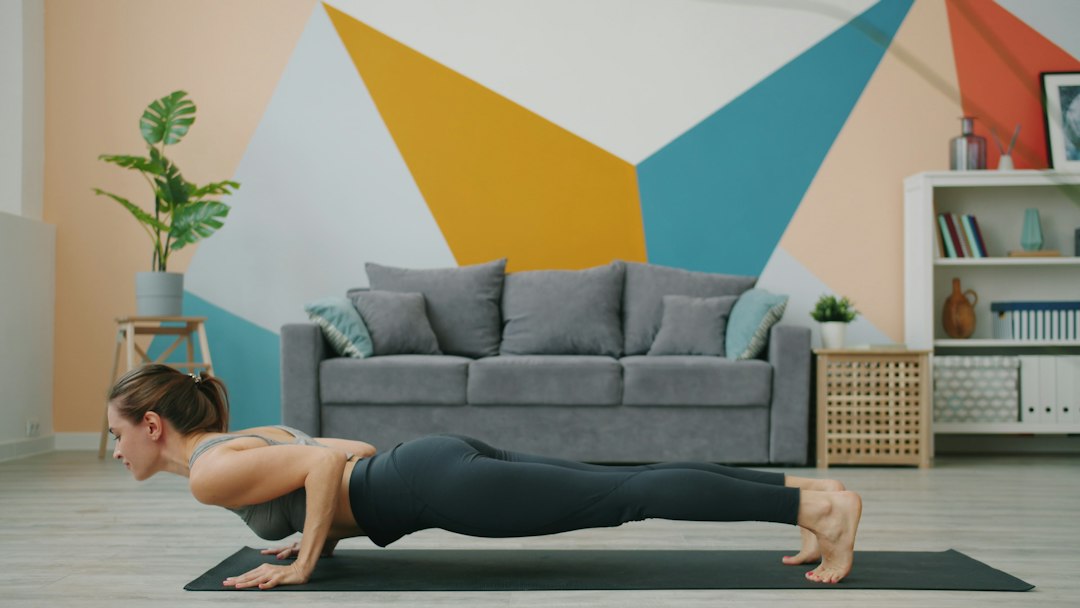
Yes—eight minutes is enough to train your core if you use focused intervals and good form. Here is your 8 minute ab workout: set a timer for 40 seconds of work and 20 seconds of rest, repeated for eight moves to total 8:00.
Do these moves in order: Plank, Reverse Crunch, Russian Twists, Bicycle Crunch, Plank Shoulder Taps, Straight‑Leg Raises, Side Plank (Left), Side Plank (Right). Use the beginner or advanced options below and repeat this 2–4 times per week. If anything causes sharp pain, stop and switch to a gentler option.
8 minute ab workout: your exact 8‑move, 8:00 circuit
Set your timer to 8 rounds of 40 seconds work and 20 seconds rest. Move through the list below once. Beginners can shorten work to 30 seconds and extend rest to 30 seconds. Advanced athletes can extend work to 45 seconds and reduce rest to 15 seconds, but keep movement quality as the top priority.
Micro warm‑up (1 minute):
- 10 standing marches with arm reach
- 10 slow torso twists
- 10 cat‑camel on hands and knees (or hands elevated on a bench if wrists feel sensitive)
Cooldown (1 minute):
- Gentle child’s pose breathing x 30–45 seconds
- Supine knee‑to‑chest hold x 10–15 seconds each side
Wrist‑friendly swaps: If planks bother your wrists, try forearm planks, elevate your hands on a sturdy bench or couch edge, or use closed‑fist planks. If floor work is uncomfortable, see the standing alternatives section.
| Exercise | Focus area | Work time | Rest time | Key cue | Beginner modification | Advanced upgrade | Notes/rep count |
|---|---|---|---|---|---|---|---|
| Plank | Deep core, anti‑extension | 40 s | 20 s | Ribs stacked over pelvis, squeeze glutes | Forearm plank, knees down | Plank with slow leg lifts | Hold steady, minimal sway |
| Reverse Crunch | Lower abs | 40 s | 20 s | Press lower back into floor | Knees bent to 90°, small range | Reverse crunch + controlled hip lift | Slow up, slower down |
| Russian Twists | Obliques | 40 s | 20 s | Keep chest tall, rotate through torso | Heels on floor, tiny range | Feet elevated, slow and controlled | Exhale on each twist |
| Bicycle Crunch | Upper/lower abs + obliques | 40 s | 20 s | Elbow to opposite knee, neck neutral | Slow march with small reach | Pause 1 s at each contact | Quality over speed |
| Plank Shoulder Taps | Anti‑rotation | 40 s | 20 s | Feet wider, hips quiet | Taps from elevated plank | Slow 3‑count tap each side | Minimal body shift |
| Straight‑Leg Raises | Lower abs | 40 s | 20 s | Zip ribs down, small range if needed | Single‑leg alternating raises | Toe tap to floor with 1 s hover | Hands under hips if needed |
| Side Plank (Left) | Obliques, lateral line | 40 s | 20 s | Shoulder over elbow, long line | Knees bent side plank | Star side plank (top leg raise) | Stack feet or stagger |
| Side Plank (Right) | Obliques, lateral line | 40 s | 20 s | Shoulder over elbow, long line | Knees bent side plank | Star side plank (top leg raise) | Match time from left |
Tips for timing: Use an interval app with a 40/20 preset and set distinct start/stop beeps. Place the phone where you can see the countdown without craning your neck.
Form cues that protect your back and neck
These cues keep tension where you want it—the abs and deep core—and help your spine feel supported. If in doubt, reduce range or choose the easier option and rebuild from there.
- Press your lower back down during floor moves. Imagine gently zipping your ribs toward your pelvis, especially on reverse crunches and leg raises.
- Stack ribs over pelvis in planks and standing options. If your hips sag or your chest drops, shorten the hold or go to knees and reset.
- Neutral neck. Look slightly ahead on planks and straight up on crunch variations. Avoid yanking your head; let your hands cradle but not pull.
- Minimize hip sway in planks. Widen your feet, squeeze glutes, and move slowly on shoulder taps so your torso stays quiet.
- Slow, controlled reps with a full exhale on effort. Exhale as you lift or rotate; inhale on the return. Breathing is your built‑in brace.
Common mistakes and quick fixes:
- Arching the lower back on leg raises: bend your knees or reduce the range until your back stays glued down.
- Rushing reps: use a 2‑second lift, 2‑second lower guideline; it often feels easier on the neck and more targeted on your core.
- Holding your breath: count soft exhales out loud to keep breathing steady.
- Elbows flaring on bicycles: keep your chest wide and rotate from the ribcage more than the elbows.
Progressions: get stronger in 4 weeks
This plan helps you turn a quick circuit into real progress, using simple benchmarks and a steady rise in demand. Rate each session by effort using RPE, aiming for a 7–8 out of 10 by the end of each circuit. If your form slips below your standards, lower the difficulty and finish strong.
Week 1 (base): 30–40 seconds work, 20–30 seconds rest depending on your current level. Choose the beginner options for any move that challenges your control. Benchmarks: note your longest steady plank without hips sagging, the number of smooth reverse crunches you can perform in 40 seconds without your back lifting, and your side plank time on each side.
Week 2 (consistency): Standard 40/20 across the board. Try to improve one benchmark: hold a cleaner plank for +10 seconds, add 2–3 quality reverse crunch reps, or reduce hip sway in shoulder taps. Stay at RPE 7–8.
Week 3 (progress): Upgrade 1–2 exercises to their advanced versions. Examples: elevate feet for Russian twists, pause at the top of bicycles, or add controlled toe taps to leg raises. Optionally shorten rest to 15 seconds for 2–4 of the rounds. Update benchmarks again.
Week 4 (peak and reassess): Either maintain advanced versions with 40/20 or keep standard versions and extend the work to 45 seconds while holding form. Check RPE and keep it near 8 by the final round. Retest your plank hold and side plank hold; aim for smoother, more stable control rather than chasing a number at all costs.
After 4 weeks: You can add a second round once per week if time allows, swap in harder moves (e.g., hollow body hold, dead bug with banded arm pull, Copenhagen side plank), or add light load to Russian twists. If you want a slightly longer routine that still requires no equipment, see our 10 Minute Deep Core Workout for a complementary session.
Standing and wrist‑friendly alternatives
No floor? No problem. Keep the 40/20 timer and swap in these options. They target the same patterns—anti‑extension, anti‑rotation, and rotation—without getting on the ground or loading your wrists.
- Standing knee drives: Hands overhead, pull one knee up while you exhale and brace. Alternate every 2–3 reps. Focus: lower abs and bracing.
- Standing oblique crunches: Hands light behind head, bring elbow toward same‑side knee with a tall posture. Focus: obliques without side bending the neck.
- March‑to‑twist: March in place and add a gentle torso twist toward the lifted knee. Slow tempo. Focus: controlled rotation and breath.
- Forearm plank on a bench: Elbows on a bench or sturdy couch edge. Focus: deep core with less wrist load.
- Dead bug arms‑only: Lie on your back with knees bent, extend arms overhead and pull back down while keeping the lower back down. Focus: anti‑extension control. If floor is uncomfortable, try a thick mat or do a standing wall dead bug—press forearms into a wall and alternate knee lifts.
- Side‑lying options: Side‑lying hip lift holds or clamshell holds emphasize lateral stability without bearing weight on hands.
Mix and match these to keep the 8‑move structure. For example, replace Plank with a bench forearm plank, and Plank Shoulder Taps with march‑to‑twist. Keep the rest of the routine as written.
How often to do abs and how to pair with other training
Most people do well with this circuit 2–4 days per week, leaving at least one day between harder core sessions. You can place it after a light warm‑up as a primer before strength work, or at the end of a workout as a finisher. If time permits, add a second round once a week, but only if your technique stays consistent.
Pairing ideas:
- With full‑body strength: Do this circuit after your main lifts. For a simple strength plan to plug in, see Beginner Strength Training Plan for Busy Adults.
- With cardio: Add 15–20 minutes of low‑impact cardio to support recovery on another day. If joints appreciate a gentler pace, try our Low impact cardio workouts.
- Rest days matter: Build at least one easier day into your week so your core feels fresh for the next session. Sleep and hydration help, too.
Safety note: Train on a stable surface with enough space around you, and avoid craning your neck to see the timer.
FAQs: calories, easiest ab exercise, “great 8,” and how many moves to do
Is 8 minutes enough to work abs effectively? Yes—consistency and intent matter more than duration. Eight minutes of focused work 2–4 times per week can build a stronger, more responsive core. If you want to do more, add a second round once per week or pair with a short walk.
What’s the easiest ab exercise that still works? A forearm plank with knees down is friendly for many beginners and teaches bracing without moving parts. Keep ribs stacked over your pelvis and exhale gently every few seconds. Another option is a dead bug arms‑only variation—lower back pressed down, tiny arm arcs, slow breathing.
How many calories does a 10 minute abs workout burn? A quick abs session typically uses roughly 30–80 calories in 8–10 minutes depending on body size, pace, and how much you move the limbs. A simple self‑estimate: multiply your body weight in kg by around 3–5 kcal for 10 minutes if you keep good tempo and breathing. The goal of core work is tension and control more than calorie burn; think quality first.
What are the “great 8” exercises? In this guide, the great eight are the exact eight moves listed in the circuit: Plank, Reverse Crunch, Russian Twists, Bicycle Crunch, Plank Shoulder Taps, Straight‑Leg Raises, Side Plank (Left), and Side Plank (Right). They cover anti‑extension, rotation, anti‑rotation, and lateral stability.
How many ab exercises should I do in one session? Four to eight movements is plenty for most people, especially if they hit different angles: a brace (plank), a lower‑abs driver (reverse crunch or leg raise), a rotation or anti‑rotation drill (twists or shoulder taps), and a lateral hold (side plank). The 8‑move plan here keeps variety without redundancy.
Printable checklist and timer guide
Here’s a compact checklist you can screenshot or print:
- Timer: 8 rounds x 40 s work / 20 s rest (total 8:00). Distinct start/stop sound.
- Moves in order: Plank → Reverse Crunch → Russian Twists → Bicycle Crunch → Plank Shoulder Taps → Straight‑Leg Raises → Side Plank L → Side Plank R.
- Form: Lower back down on floor moves, ribs over pelvis, neutral neck, slow breathing. Hips steady on planks.
- Mods: Knees‑down for planks, heels down for twists, single‑leg leg raises, forearm or elevated planks as needed.
- Upgrades: Pause reps, elevate feet in twists, toe‑tap hover on leg raises, star side plank for extra challenge.
- Safety: Stop on sharp pain. Adjust range or option if the lower back arches or neck tenses.
- Log it: Write a quick note after each session—RPE, any upgrades used, and one form cue that helped. Revisit benchmarks weekly.
Timer setup tips:
- Use any interval timer app with custom work/rest presets. Label the routine “8:00 Core 40/20” so it’s one tap away.
- Set a soft beep at 10 seconds left so you can finish reps without rushing, and a distinct bell for the rest period.
- Place your phone where you can see the countdown without craning your neck—side of the mat or on a chair near eye level.
If you’d like more ideas for ab routines and how to organize them in a week, this overview is a helpful companion: Strengthen Your Core with the Best Ab Workouts. For a complete, no‑equipment companion session, bookmark the 10 Minute Deep Core Workout and add it to another day.
Eight minutes is a small window. Keep it simple, breathe with each rep, and make every second count.